Hand-painted in oil
About this Artwork
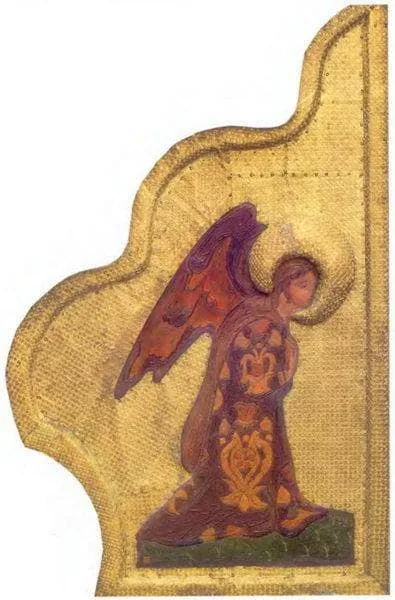
Gabriel is an office before he is a figure
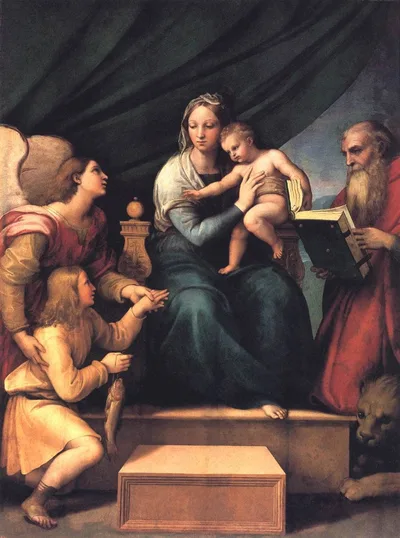
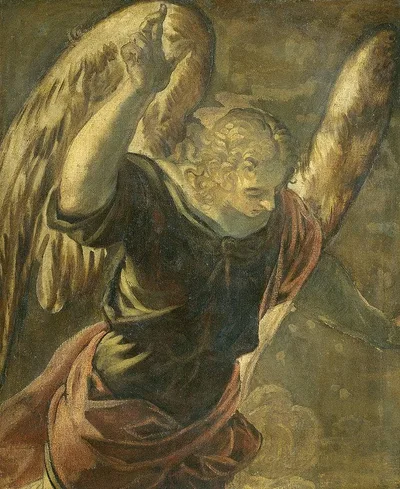
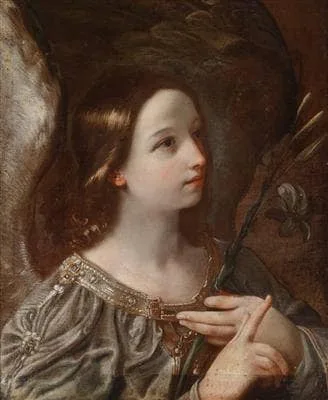
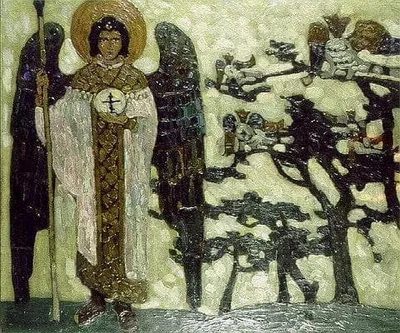
Of the three archangels the tradition names, Gabriel is the one defined entirely by an errand. His function is announcement, and the scene that fixed his image in Western art is the Annunciation. This entry's title carries both terms — the scene and the individual — which is unusually explicit: many Annunciation entries name only the event and leave the messenger unnamed, since convention supplies him.
What the record holds
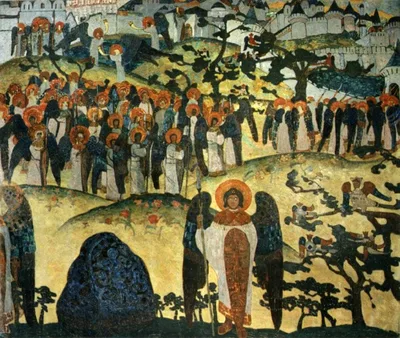
The catalogue dates the work to 1907 and gives Nicholas Roerich, a Russian painter. Two style terms are recorded, Art Nouveau Modern and Byzantine, which is a combination worth noticing: one names a turn-of-the-century idiom, the other an older pictorial system that long predates it. The measured colour family is yellow. The recorded location is the Perm State Art Gallery in Perm, Russia. No dimensions are given in the record.
A twentieth-century archangel
The Annunciation is among the oldest fixed subjects in Christian art, and by 1907 a painter approaching it was working against several centuries of settled composition. The pairing of style terms in the record is the only evidence this entry offers about how that was handled here, and it points backwards rather than forwards — towards the Byzantine register, where angels are hieratic figures of rank rather than naturalistic visitors. What the picture does with that is a matter for the image, not for the catalogue.
Sources
3 references- Nicholas Roerich Museum — Getty ULAN
American repository, New York City, contemporary
- Nicholas Roerich — Wikipedia
Nikolai Konstantinovich Rerikh (Russian: Николай Константинович Рерих), better known as Nicholas Roerich (; October 9, 1874 – December 13, 1947), was a Russian painter, writer, archaeologist, theosophist, philosopher, and public figure. He
- Roerich, Nicholas — Getty ULAN
Russian painter, 1874-1947