Hierarchy
The Celestial Hierarchy
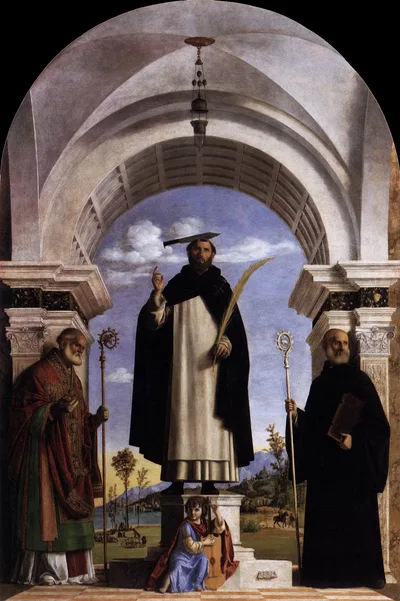
The ranking of angels comes from a sixth-century text, the Celestial Hierarchy attributed to Dionysius the Areopagite, which sorts them into nine choirs in three triads. Painting never honoured the scheme evenly. Seraphim, cherubim and archangels were given faces, wings and armour; thrones, dominions, virtues, powers and principalities were named far more often than they were depicted. This index follows the ranks that painters actually drew, and then the three archangels the tradition names, each of whom arrives in a human scene with a specific job to do.
Hierarchy · 1 of 6
The Nine Choirs
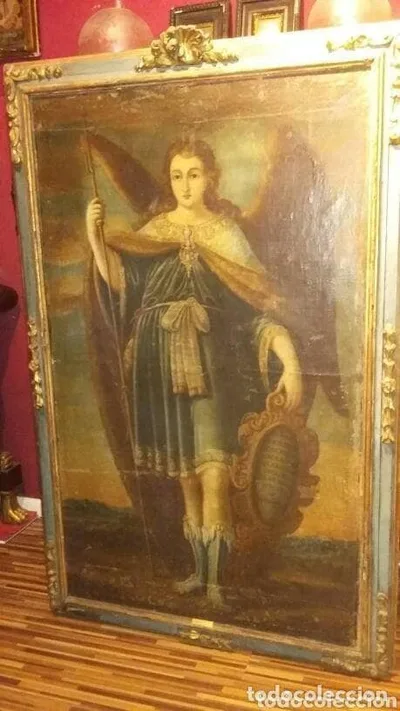
Of the nine ranks, this collection holds one: the archangels, the only choir Western painting dressed, armed and gave a face.
Of the nine ranks, painting gave a body to three, and the panel paintings that survive in oil narrow that to one. Seraphim are red and appear as heads inside six wings; cherubim are blue and usually reduced to a winged head. Both tend to occupy the border and the upper register rather than the centre, which is why a painting is rarely named after them — no work catalogued here is. Archangels are named: full figures, dressed and armed, the subject rather than the setting. Thrones, dominions, virtues, powers and principalities were named in sermons and inventories far more often than they were painted, and in this collection they are absent — which is itself the finding, not a gap in the catalogue.
Hierarchy · 2 of 6
Michael and the Fall
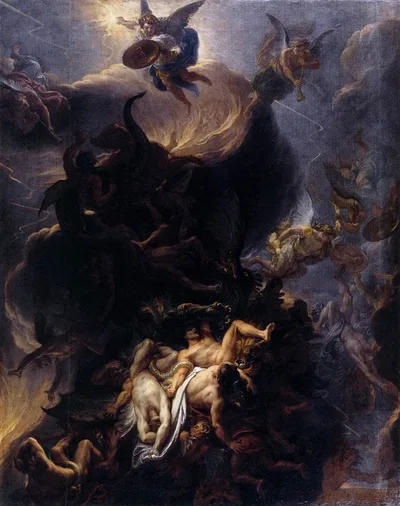
The warrior archangel in armour, scales in hand, treading on the dragon he threw out of heaven.
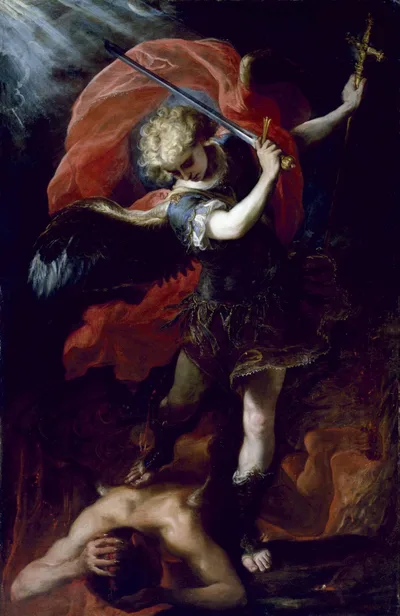
Michael is the warrior. He wears armour, carries a sword or lance, and stands on the dragon he threw out of heaven; in the weighing of souls he holds a set of scales, and a small naked figure sits in one pan. The armour dates the picture almost as reliably as the style does — painters dressed him in the plate of their own century, so Michael is wearing whatever a soldier wore when the panel was made.
Hierarchy · 3 of 6
Gabriel at the Annunciation
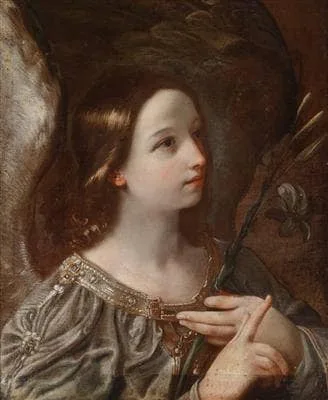
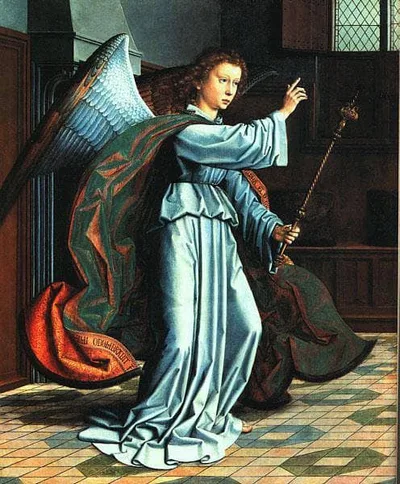
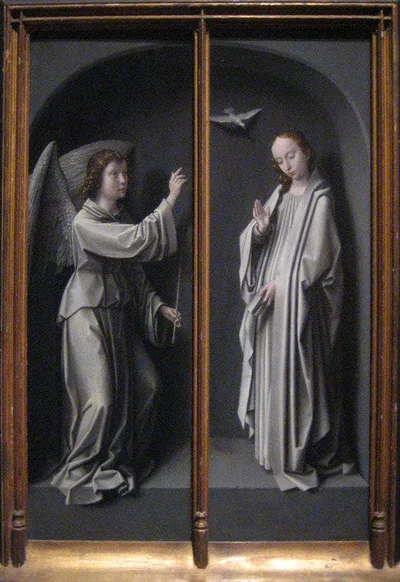
The messenger who kneels with a lily and speaks first — the single scene that fixed how an angel should look.
Gabriel exists in painting almost entirely for one scene. He arrives at the Annunciation, usually from the left, usually kneeling or just landing, carrying a lily for the Virgin's purity and sometimes a scroll with the words of the greeting. The room he arrives in is often as carefully painted as he is: the Annunciation is where painters put their perspective, their tiled floors and their most expensive blue.
Hierarchy · 4 of 6
Raphael and Tobias
The healing archangel walking a boy home with a fish and a dog: the only angel in art with a travel companion.
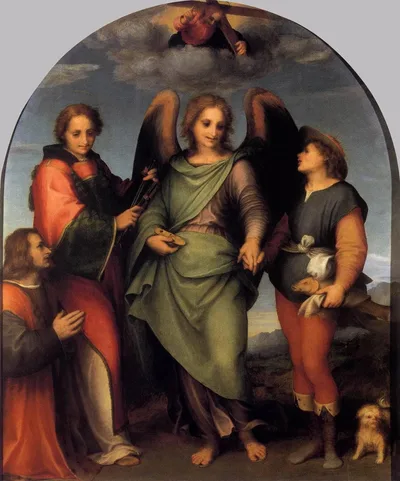
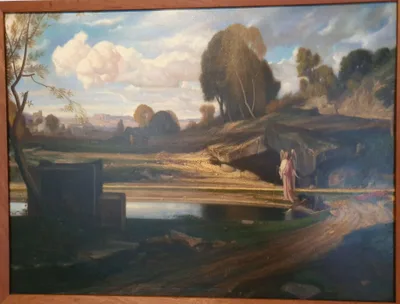
Raphael travels. He is painted as a walking companion to the boy Tobias, in a cloak, with a staff and a fish — the fish whose gall cures the father's blindness. Because the story is about a journey and a safe return, Raphael became the angel commissioned by families whose sons were away: a substantial number of these panels are votive pictures with a private reason behind them.
Hierarchy · 5 of 6
Angels of the Old Testament
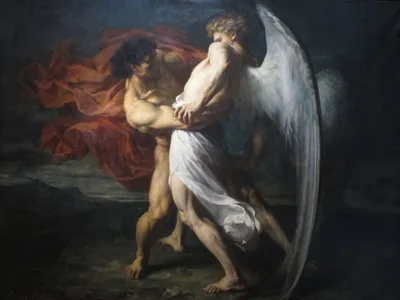
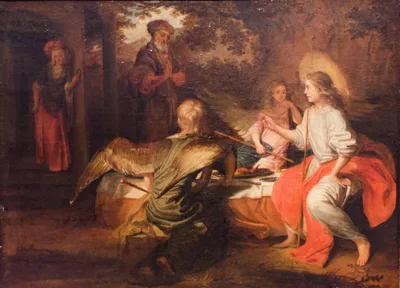
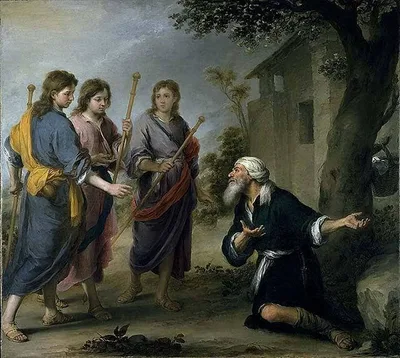
Jacob's ladder and his night of wrestling, Hagar in the desert, the strangers at Abraham's tent, Balaam's blocked road.
Before the New Testament, angels appear as strangers who turn out not to be strangers: the three visitors to Abraham, the hand that stops the knife at Isaac's throat, the ladder in Jacob's dream, the figure Jacob wrestles all night. Painters kept these encounters ambiguous on purpose — the wings often arrive late in the picture's logic, after you have already read the figure as a man.
Hierarchy · 6 of 6
Angel Musicians
Lutes, harps and open songbooks: the choir that fills the upper register of an altarpiece.
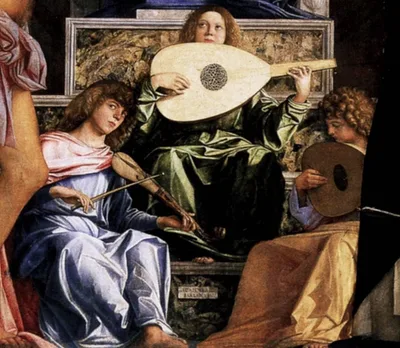
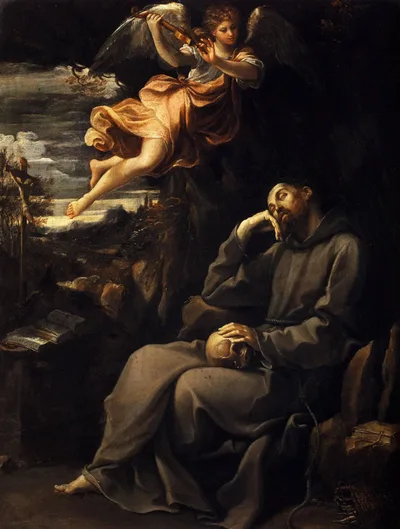
Angel musicians are the decorative end of the tradition and the most informative. Because painters worked from instruments they could see, these panels are a record of what was actually being played: lutes, portative organs, rebecs, shawms, and the way a player's hands sat on them. Musicologists read them as evidence; they were painted as the border of somebody else's altarpiece.