
Angels, Cherubim and Putti in Art
Published · Art & See editorial desk
Putto describes a familiar childlike figure in art, while cherubim names a rank of angels. The words can overlap in museum descriptions, but a small winged child in a painting is not automatically evidence for a particular angelic order. [1][2]
What the terms establish
The National Gallery’s glossary describes putti as winged infants that can appear in religious imagery or in scenes of worldly love associated with Cupid. Context therefore matters: a similar visual form can serve different roles. [1]
The same glossary describes cherubim as an angelic rank and notes their frequent appearance alongside seraphim in religious art. It discusses childlike or winged-head forms and acknowledges that they are sometimes called putti. This is an overlap in artistic vocabulary, not permission to identify every putto as a cherub. [2]
| Term | What the word names | Form described in these sources | Overlap to watch |
|---|---|---|---|
| Putto (plural putti) | A figure type rather than an angelic rank: winged infants who either play the role of angelic spirits in religious works, or act as instruments of profane love [1] | A winged infant, often shown as an associate of Cupid; the word comes from Greek and Roman antiquity, from the Latin putus, little man [1] | The glossary entry for cherubim says cherubim are sometimes referred to as putti [2] |
| Cherub (plural cherubim) | One of the ranks of angels [2] | Usually children with two or three pairs of red or blue wings around their heads, sometimes winged heads alone; blue, with blue flames on their heads, in the San Pier Maggiore pinnacle panel [2][3] | Frequently appear together with seraphim in altarpieces and religious paintings [2] |
| Seraph (plural seraphim) | A different rank of angelic being from the cherubim [3] | Red, with six wings and red flames upon their heads, in the San Pier Maggiore pinnacle panel [3] | Named beside the cherubim in that same panel, so the two ranks are told apart there by colour, not by age or size [3] |
Definitions from the National Gallery glossary entries for putti and cherubim; the red and blue description belongs to the Gallery's entry on NG572 and is a reading of that ensemble, not a rule for every date or tradition. [1][2][3]
A painting that names the ranks
Jacopo di Cione and workshop’s Seraphim, Cherubim and Adoring Angels: Right Pinnacle Panel belongs to the San Pier Maggiore altarpiece. The National Gallery dates it 1370–1 and records it as NG572. Its description identifies the red figures as seraphim and the blue figures as cherubim; other angels below play instruments or carry incense. [3]
Here the classification is grounded in an identified altarpiece and its catalogue. Do not turn its colour scheme into a universal rule for paintings of every date or tradition. The useful evidence is the institution’s interpretation of this particular ensemble.


Putti in a mythological setting
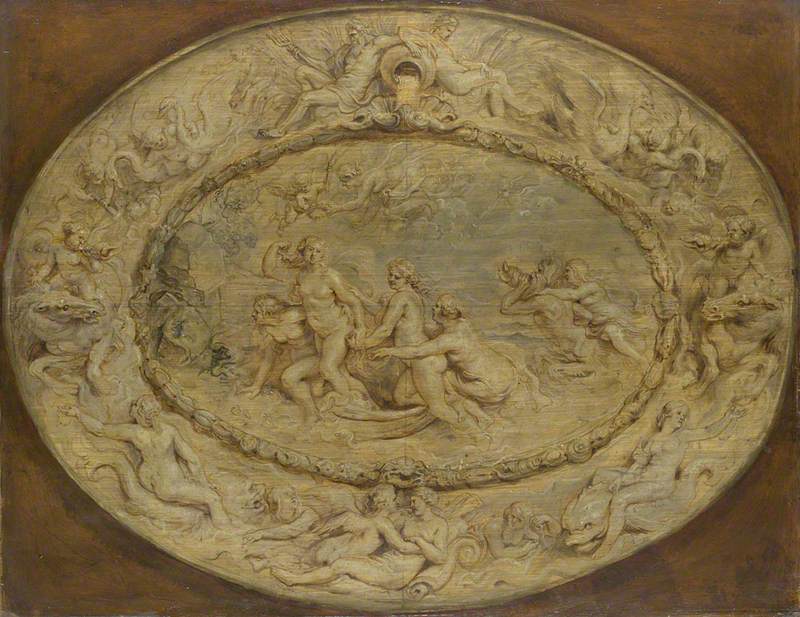
In Rubens’s The Birth of Venus, a design for a silver basin, the National Gallery identifies putti among the figures around the mythological scene. Venus, Neptune and other classical figures supply a different setting from Jacopo’s Christian altarpiece. Calling those children putti describes their role in the design without making them members of a Christian angelic choir. [4]
_-_The_Birth_of_Venus_-_NG1195_-_National_Gallery.jpg)
An angel can remain unnamed
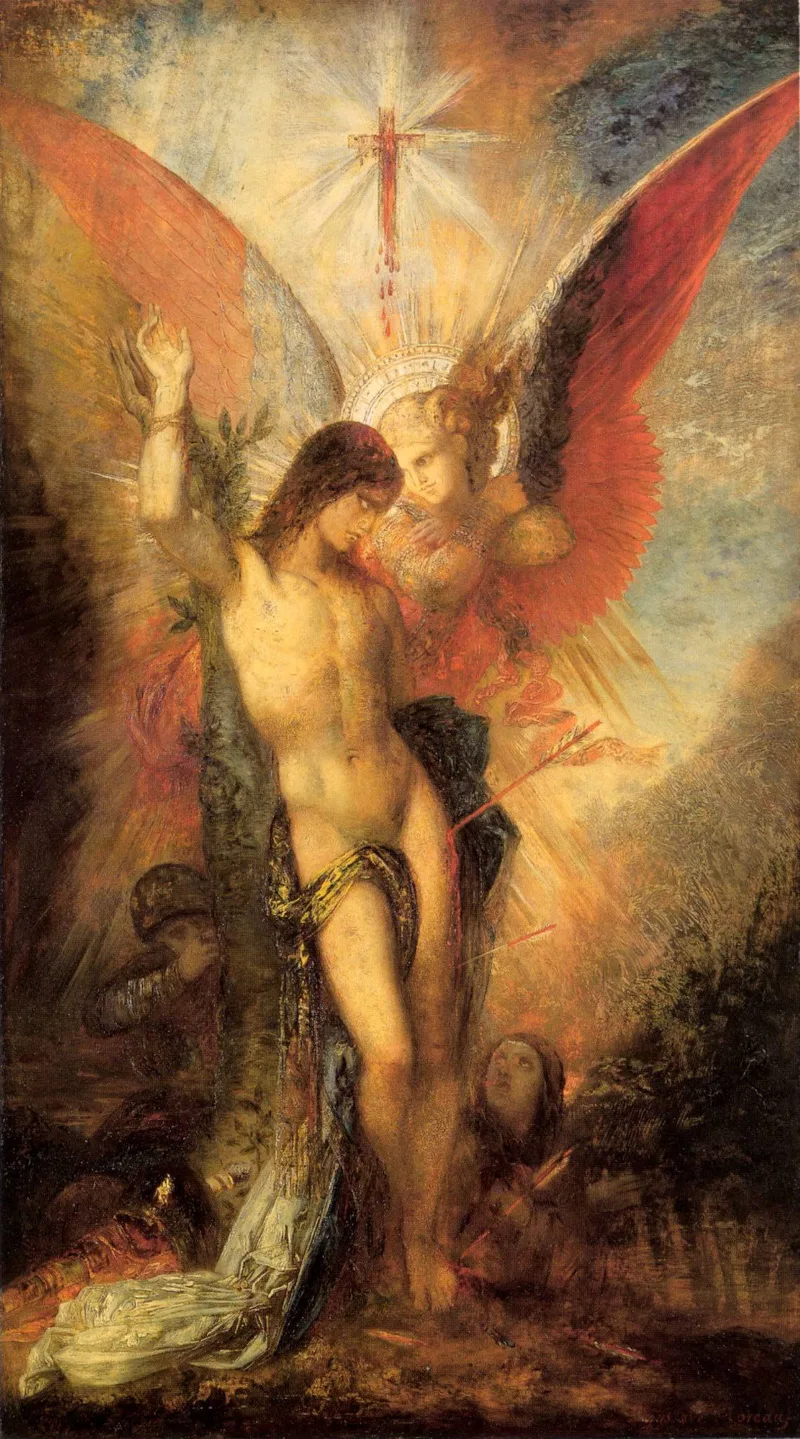
Harvard Art Museums identifies Moreau’s painting as Saint Sebastian and the Angel and describes a winged figure beside Sebastian. The museum’s object record does not assign that figure to the cherubim or identify it as Michael, Gabriel or Raphael. The title supports “angel”; a more specific identity would require additional evidence. [5]
For an unfamiliar work, record three things separately: the figure’s visible form, its named role in the catalogue, and any documented theological rank. Leaving the last field unresolved is more accurate than treating youthfulness, wings or proximity to a saint as a complete identification.
Sources
- National Gallery glossary: PuttiAccessed .
- National Gallery glossary: CherubimAccessed .
- National Gallery: Jacopo di Cione and workshop, Right Pinnacle Panel, NG572Accessed .
- National Gallery: Rubens, The Birth of Venus, NG1195Accessed .
- Harvard Art Museums: Moreau, Saint Sebastian and the Angel, 1943.265Accessed .