Hand-painted in oil
About this Artwork
The top of the scheme and one representative
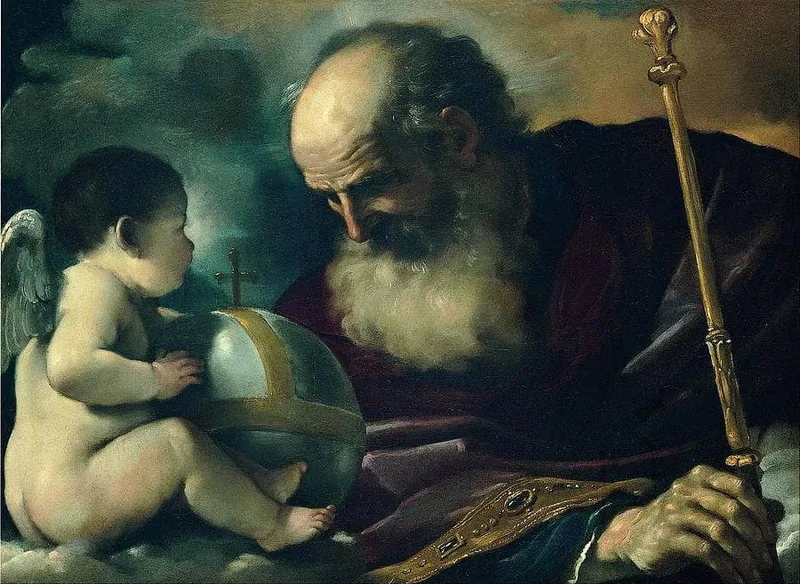
Two terms, and between them the entire hierarchy is left out. God the Father is the point the whole scheme is measured from — the orders are ranked by nearness to him — and "angel" is the ninth and lowest of those orders as well as the general word for all nine. A title pairing them omits seven ranks and the archangels too. It is the shortest statement of the hierarchy this catalogue contains, and it works by leaving out everything in the middle.
What the record holds
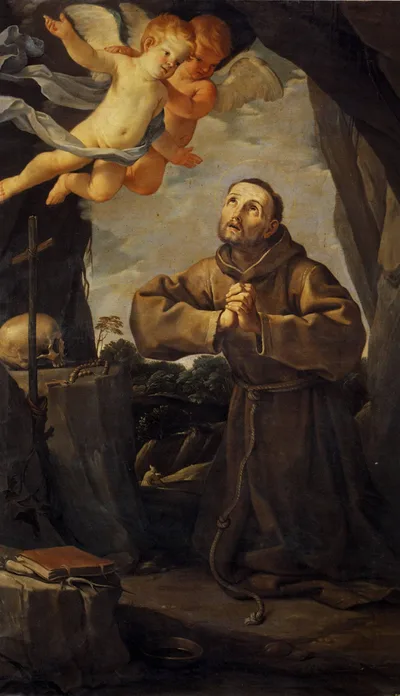
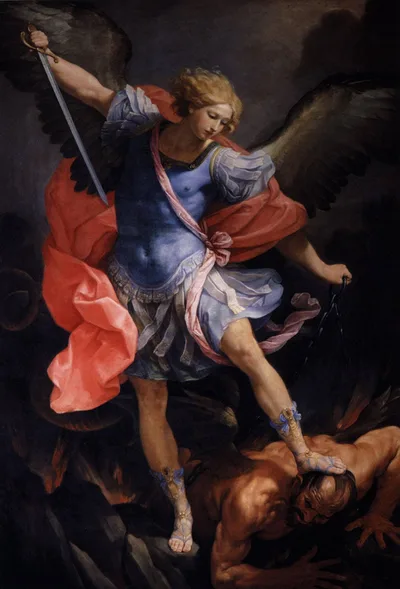
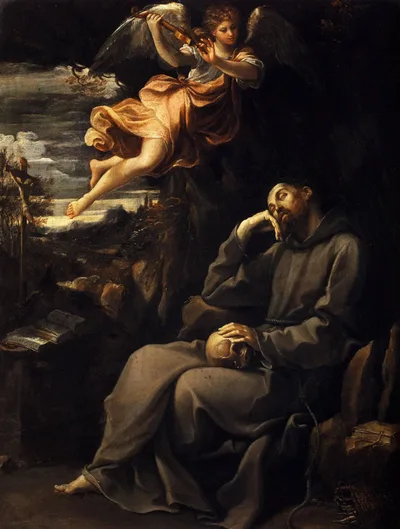
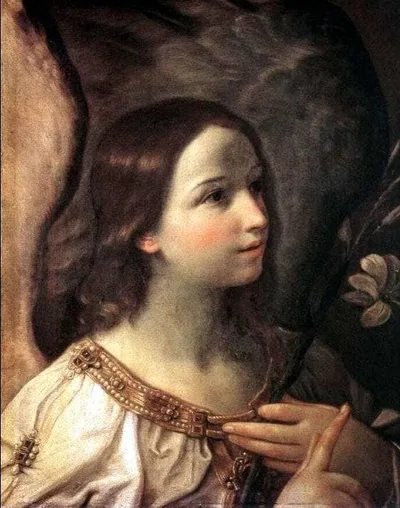
The catalogue gives Guercino, an Italian painter, filed under Baroque. The measured colour families are green and yellow. Green is rare in this record: eight of the 224 entries carry it as a measured family, against 88 for brown. No date of creation is recorded for this entry, no location is recorded, and no dimensions are recorded, so none of the three is stated here. The subject fields class the work as male portraiture and as a religious subject.
Why the middle is always missing
The omission is not this title's peculiarity. Not one of the 224 works catalogued here names a seraph, a cherub, a dominion, a virtue, a power or a principality. Sixteen name an archangel — the eighth rank — and every other angelic figure on the site arrives as a plain angel or as a category. The seven upper orders were doctrine that produced no pictures, because their offices were contemplation and governance and neither can be drawn. What can be drawn is somebody going somewhere.
Sources
5 references- Guercino — Getty ULAN
artist, probably Austrian
- Guercino — Wikipedia
Giovanni Francesco Barbieri (8 February 1591 – 22 December 1666), better known as (il) Guercino (Italian pronunciation: [ɡwerˈtʃiːno] ), was an Italian Baroque painter and draftsman from Cento in the Emilia region, who was active in Rome an
- Guercino — Getty ULAN
Italian painter, draftsman, 1591-1666
- God the Father and Angel — Wikidata
description: painting by Guercino (Giovan Francesco Barbieri); inception: 1620; dimensions: 660 × 910 cm; collection: Musei di Strada Nuova
- Guercino (Giovan Francesco Barbieri) - God the Father and Angel - Google Art Project — Wikimedia Commons
High-resolution image of the work, hosted on Wikimedia Commons.