Hand-painted in oil
About this Artwork
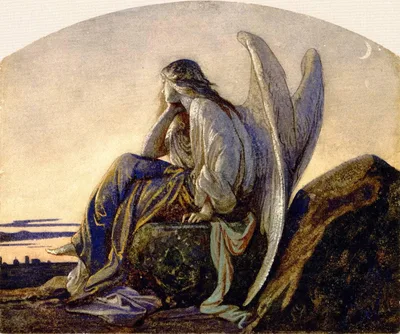
An angel by title, a different figure by tradition
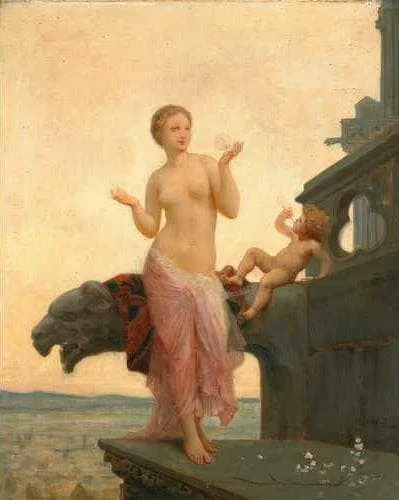
Love has a winged messenger in Western art and it is not an angel. Cupid — Amor, Eros — comes from classical mythology, arrives with a bow, and belongs to a system of gods rather than to a hierarchy of celestial servants. The two figures share wings, youth and the job of carrying something from one party to another, and academic painting merged them freely. A title like this sits exactly on the seam. The inherited nine orders contain no rank concerned with love between people; that office is entirely on the classical side.
What the record holds
The catalogue dates the work to 1884 and gives Henri-Pierre Picou, a French painter, with the style term Academicism. The measured colour family is yellow. No location is recorded for this entry and no dimensions are recorded, so neither is stated here. The subject fields class the work as female portraiture, which — as elsewhere on this site — records how a figure reads rather than what the doctrine holds angels to be.
Why the seam matters here
This site catalogues 224 works, and a substantial share arrive by way of the word rather than the figure: thirty-three titles containing evangelist, six containing Angelica, five naming Castel Sant'Angelo. Those are homonyms and can be identified as such. A title like this one is a harder case, because the word is meant and the figure behind it may be classical. The honest entry states both and does not choose.
Sources
4 references- Picou, Henri Pierre — Getty ULAN
artist, born 1824
- Henri-Pierre Picou — Wikipedia
Henri-Pierre Picou (Nantes 27 February 1824 – 17 July 1895) was a French painter. His oeuvre began with portraits and classical historical subject matter but he later moved on to allegorical and mythological themes. He was an academic paint
- Angel of Love — Wikidata
description: painting by Henri-Pierre Picou; inception: 1884; dimensions: 60.3 × 50.8 cm
- Henri Pierre Picou--Angel of Love--1884 — Wikimedia Commons
High-resolution image of the work, hosted on Wikimedia Commons.