Hand-painted in oil
About this Artwork
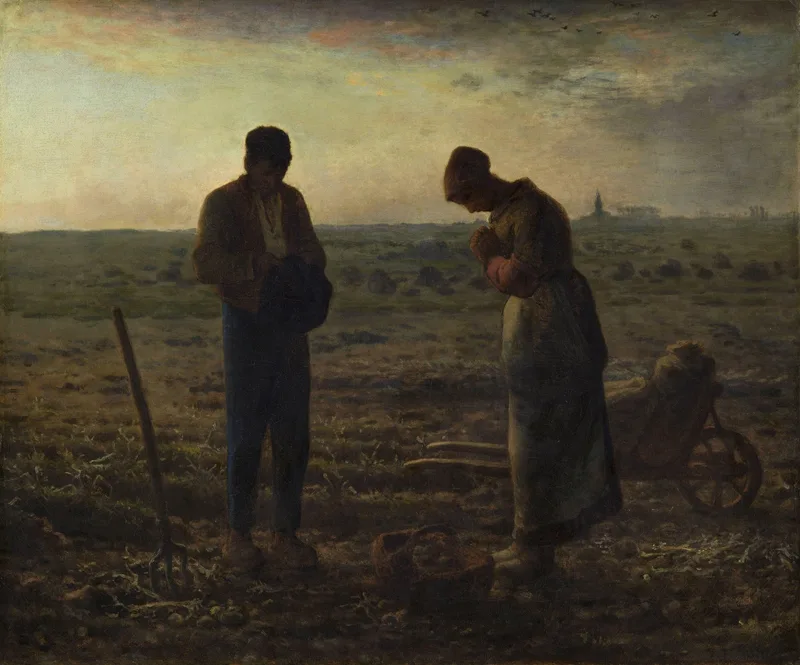
The Angelus is a prayer
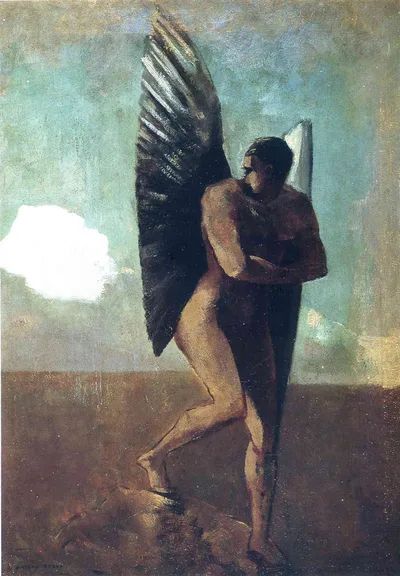
The Angelus is a devotion named for its opening Latin words, Angelus Domini nuntiavit Mariae, and it is said at fixed hours at the sound of a bell. The word in this title refers to that prayer, not to a being. No angel is claimed anywhere in this record. Two of the 224 titles in this catalogue carry the word in that sense, and both are nineteenth-century.
What the record holds
The catalogue dates the work to 1859 and gives Jean-Francois Millet, a French painter, with Realism as the style term. The recorded dimensions are 55.5 x 66 cm. The measured colour families are brown and yellow. The location on record is Musée d’Orsay, Paris, France.
What the record files instead
The subject tags here are Landscapes, Field and Portraits of a group, with Realism as the style term — a picture of agricultural labour interrupted by an hour. That is a long way from a hierarchy of nine orders, and the distance is exactly the point of flagging it. The entry is one of three in this catalogue recorded at the Musée d'Orsay.
Sources
6 references- Millet, Jean François — Getty ULAN
French landscapist, 1666-1723
- Jean-François Millet — Wikipedia
Jean-François Millet (French pronunciation: [ʒɑ̃ fʁɑ̃swa milɛ]; 4 October 1814 – 20 January 1875) was a French painter and one of the founders of the Barbizon school in rural France. Millet is noted for his paintings of peasant farmers and
- Millet, Jean-François — Getty ULAN
French painter and draftsman, 1814-1875
- The Angelus — Wikidata
description: painting by Jean-François Millet in the Musée d'Orsay; inception: 1858; dimensions: 55.5 × 66 cm; collection: Musée d'Orsay
- The Angelus (painting) — Wikipedia
The Angelus (French: L'Angélus) is an oil painting by French painter Jean-François Millet, completed between 1857 and 1859. The painting depicts two peasants in a field bowing over a basket of potatoes, while saying a prayer, the Angelus. T
- smarthistory.khanacademy.org — reference for "The Angelus (painting)"
Authoritative source for this work (smarthistory.khanacademy.org).