Hand-painted in oil
About this Artwork
The order that guards the gate
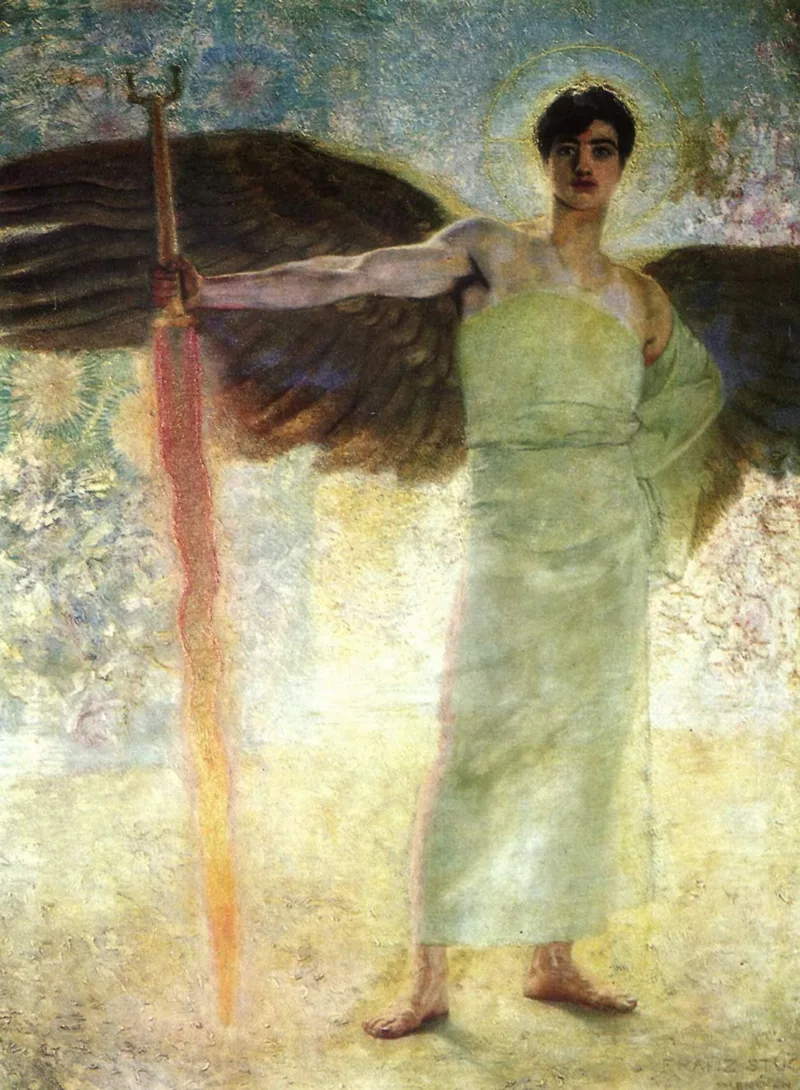
A flaming sword has one anchor in the tradition: the guard set at the east of Eden, which Genesis assigns to cherubim. That is the one occasion on which the second order of the first triad — the rank immediately below the seraphim — is given a physical task in the text, and the task is armed sentry duty. Elsewhere the cherubim contemplate. It is worth stating plainly that this catalogue contains no title naming a cherub at all: the count is zero across 224 entries, and this title, which describes the cherub's own attribute, calls the figure simply an angel.
What the record holds
The catalogue dates the work to 1889 and gives Franz Stuck, filed as German, with the style term Symbolism. It measures 250 x 167 cm — upright and large. The measured colour family is yellow. No location is recorded for this entry, so no collection is named here. The record files the subject under female portraiture and under religion.
An attribute that outlived its rank
This is the only title in the catalogue that names a flaming sword. The attribute survived; the order it belonged to did not, at least not in a form a painter could use. By this date the useful angelic vocabulary had shrunk to wings, a weapon and a posture, and a symbolist could take the sword without taking the cherub — which is how a rank disappears from painting while its equipment stays in circulation.
Sources
4 references- Stuck, Franz von — Getty ULAN
German painter, sculptor, and draftsman, 1863-1928
- Franz von Stuck — Wikipedia
Franz Ritter von Stuck (February 23, 1863 – August 30, 1928), born Franz Stuck, was a German painter, sculptor, printmaker, and architect. Stuck was best known for his paintings of ancient mythology, receiving substantial critical acclaim w
- the angel of the Paradis — Wikidata
description: painting by Franz v. Stuck; dimensions: 250 × 167 cm; collection: Munich Central Collecting Point
- dhm.de — record for "the angel of the Paradis"
Primary source record for this work (dhm.de).